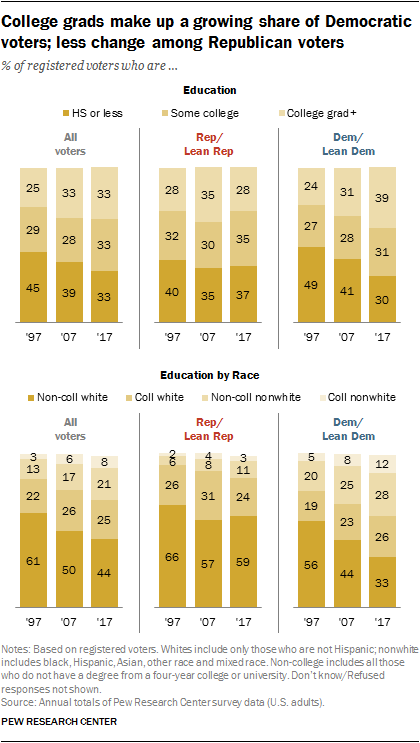
Only Wyoming has a majority of registered voters identifying themselves as Republicans; two states have a majority of registered voters identifying themselves as Democrats: Maryland and Kentucky (since 2010, Louisiana, Pennsylvania and West Virginia have all seen their Democratic-majority registrations slip to just Democratic-pluralities).
For climate skeptics, it’s hard to compete with the youthful appeal of global phenomenon Greta Thunberg. But one U.S. think tank hopes it’s found an answer: the anti-Greta.
Naomi Seibt is a 19-year-old German who, like Greta, is blond, eloquent and European. But Naomi denounces “climate alarmism,” calls climate consciousness “a despicably anti-human ideology,” and has even deployed Greta’s now famous “How dare you?” line to take on the mainstream German media.
“She’s a fantastic voice for free markets and for climate realism,” said James Taylor, director of the Arthur B. Robinson Center for Climate and Environmental Policy at the Heartland Institute, an influential libertarian think tank in suburban Chicago that has the ear of the Trump administration.
In December, Heartland headlined Naomi at its forum at the UN climate conference in Madrid, where Taylor described her as “the star” of the show. Last month, Heartland hired Naomi as the young face of its campaign to question the scientific consensus that human activity is causing dangerous global warming.
“Naomi Seibt vs. Greta Thunberg: whom should we trust?” asked Heartland in a digital video. Later this week, Naomi is set to make her American debut at the Conservative Political Action Conference, or CPAC, a high-profile annual gathering just outside Washington of right-leaning activists.
If imitation is the highest form of flattery, Heartland’s tactics amount to an acknowledgment that Greta has touched a nerve, especially among teens and young adults. Since launching her protest two years ago outside the Swedish parliament at age 15, Greta has sparked youth protests across the globe and in 2019 was named Time magazine’s “Person of the Year,” the youngest to ever win the honor.
Bannon (p. 156): "The modern economics of the newsroom don't support big investigative reporting staffs. You wouldn't get a Watergate, a Pentagon Papers today, because nobody can afford to let a reporter spend seven months on a story. We can. We're working as a support function."
Wynton Hall (p. 157): “We live and die by the media. Every time we're launching a book, I'll build a battle map that literally breaks down by category every headline we're going to place, every op-ed Peter's going to publish. ... Getting our message embedded in mainstream outlets is what gets us the biggest blast radius."
The IRA [Internet Research Agency, Russian troll farm in St. Petersberg] organized and promoted political rallies inside the United States while posing as U.S. grassroots activists. First, the IRA used one of its preexisting social media personas (Facebook groups and Twitter accounts, for example) to announce and promote the event. The
IRA then sent a large number of direct messages to followers of its social media account asking them to attend the event. From those who responded with interest in attending, the IRA then sought a U.S. person to serve as the event's coordinator. In most cases, the IRA account operator would tell the U.S. person that they personally could not attend the event due to some preexisting conflict or because they were somewhere else in the United States. The IRA then further promoted the event by contacting U.S. media about the event and directing them to speak with the coordinator. After the event, the IRA posted videos and photographs of the event to the IRA's social media accounts.
The Office identified dozens of U.S. rallies organized by the IRA. The earliest evidence of a rally was a "confederate rally" in November 2015. ... From June 2016 until the end of the presidential campaign, almost all of the U.S. rallies organized by the IRA focused on the U.S. election, often promoting the Trump Campaign and opposing the Clinton Campaign. Pro-Trump rallies included three in New York; a series of pro-Trump rallies in Florida in August 2016; and a series of pro-Trump rallies in October 2016 in Pennsylvania. The Florida rallies drew the attention of the Trump Campaign, which posted about the Miami rally on candidate Trump's Facebook account (as discussed below).
Across much of America, conservatives can mount powerful state legislative campaigns through three well-funded networks that operate as complements to one another. Think tanks affiliated with the State Policy Network (SPN) spew out studies and prepare op-eds and legislative testimony. Paid state directors and staffers installed by Americans for Prosperity (AFP)sponsor bus tours, convene rallies and public forums, run radio and television ads, send mailers, and spur activists to contact legislators. And inside the legislatures themselves, many representatives and senators, especially Republicans, are members of ALEC, which invites them to serve alongside business lobbyists and right-wing advocacy groups on national task forces that prepare “model” bills that the legislators can advance at the state and local level, with assistance from ALEC staffers.
DLC fades with the disappearance of conservative Southern Democrats. Democratic share of Southern (CQ def) House seats 87th Congress (1961-62).....93.4% 103d Congress (1993-94)....61.6% 104th Congress (1994-96)...48.8% -- Gingrich 115th Congress (2017-217)..28.0%
Buckley v. Valeoand the part of the decision that allows for Bloomberg (Hershey 285):
2. Limitation on Expenditures by Candidates from Personal or Family Resources. The Act also sets limits on expenditures by a candidate "from his personal funds, or the personal funds of his immediate family, in connection with his campaigns during any calendar year." ... The primary governmental interest served by the Act -- the prevention of actual and apparent corruption of the political process -- does not support the limitation on the candidate's expenditure of his own personal funds. As the Court of Appeals concluded:" Manifestly, the core problem of avoiding undisclosed and undue influence on candidates from outside interests has lesser application when the monies involved come from the candidate himself or from his immediate family."171 U.S.App.D.C. at 206, 519 F.2d at 855. Indeed, the use of personal funds reduces the candidate's dependence on outside contributions, and thereby counteracts the coercive pressures and attendant risks of abuse to which the Act's contribution limitations are directed. [Footnote 59] The ancillary interest in equalizing the relative financial resources of candidates competing for elective office, therefore, provides the sole relevant rationale for § 608(a)'s expenditure ceiling. That interest is clearly not sufficient to justify the provision's infringement of fundamental First Amendment rights. First, the limitation may fail to promote financial equality among candidates. A candidate who spends less of his personal resources on his campaign may nonetheless outspend his rival as a result of more successful fundraising efforts. Indeed, a candidate's personal wealth may impede his efforts to persuade others that he needs their financial contributions or volunteer efforts to conduct an effective campaign. Second, and more fundamentally, the First Amendment simply cannot tolerate § 608(a)'s restriction upon the freedom of a candidate to speak without legislative limit on behalf of his own candidacy. We therefore hold that § 608(a)'s restriction on a candidate's personal expenditures is unconstitutional.
BCRA and McConnell v. FEC: "We are under no illusion that BCRA will be the last congressional statement on the matter. Money, like water, will always find an outlet.
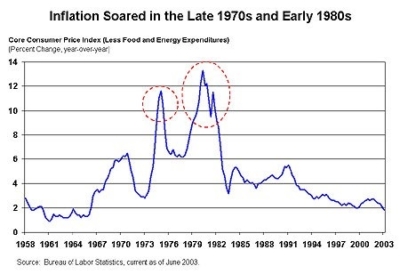
Oil shocks (1973 OPEC and 1979 Iran) begat inflation, which begat rising nominal property values and bracket creep, which begat Prop 13 (1978) and Kemp-Roth
DLC (275) and Clintonism -- DLC fades with the disappearance of conservative Southern Democrats. Democratic share of Southern (CQ def) House seats 87th Congress (1961-62).....93.4% 103d Congress (1993-94)....61.6% 104th Congress (1994-96)...48.8% -- Gingrich 115th Congress (2017-217)..28.0%
You are receiving this email because you are registered to vote with No Party Preference.
If you want to vote for U.S. President in the March 3, 2020 Presidential Primary Election, you must request a ballot with presidential candidates.
If you have already requested a ballot from your county elections office no further action is needed. You will be mailed a ballot with presidential candidates from the party you selected. Political party rules…
Three parties allow No Party Preference voters to participate in their Presidential Primary Elections:
American Independent Party
Democratic Party
Libertarian Party
If you want to vote for the Green, Peace and Freedom, or Republican Parties' presidential candidates, you must re-register with that specific party.
NOTE: The political parties decide if they will allow No Party Preference voters to participate in their presidential primaries.
If your vote-by-mail ballot does not have presidential candidates…
The default ballot for No Party Preference voters has no presidential candidates on it. If you want to a vote for a presidential candidate, do NOT cast this ballot. You can request a replacement ballot with presidential candidates from your county elections office by:
You can also bring your vote-by-mail ballot to your local polling place or vote center and exchange it for a ballot with presidential candidates.
If you vote at the polls…
Ask the poll worker for a ballot with either American Independent, Democratic, or Libertarian Party presidential candidates when checking-in at a polling place or vote center.
If you want to vote for Green, Peace and Freedom, or Republican Party presidential candidates you can complete the 'Same-Day' voter registration process at the polling place or vote center.
To re-register to vote...
You can re-register to vote online at registertovote.ca.gov. If you need to re-register after February 18, 2020, you can do so in person at a polling place, any vote center, or your county elections office
Dear California Voter,
When you vote by mail, have you ever wondered, "where's my ballot?" There’s a new tool from the Secretary of State and your county elections office that you can use to get automated updates on your vote-by-mail ballot — when it's mailed to you, when it’s received by your county, and when it’s been counted.
You can sign-up easily at WheresMyBallot.sos.ca.gov to receive automated notifications by email, text (SMS), or voice call about the status of your vote-by-mail ballot.
**If you have already signed-up for "Where's My Ballot?" you do not need to take further action.**
WATCH on YouTube: How to sign-up for the "Where's My Ballot?" tool.
Voters who sign up for “Where’s My Ballot?” will receive automatic updates when:
The county elections office mails the voter’s ballot
The county has received the voter’s ballot
The county has counted the voter’s ballot
If there are any issues with the voter’s ballot
Voters who sign-up for “Where’s My Ballot?” will also receive communications from their county elections office about important election deadlines and critical updates such as polling place changes.
Sign-up is easy and can be done in minutes.
Present at the creation (Rosenfeld 190-191). Paul Weyrich, who founded Heritage and the Free Congress Foundation, spoke of the moment of inspiration in 1969, when he was a staffer for Senator Gordon Allott (R-CO).