Tuesday, March 17, 2020

Florida as a Swing State

With my home state of Florida casting its ballots today I thought it would be appropriate to link this article from the New York Times that places the Democratic Primary contest in the context of Florida's swing state status -

https://www.nytimes.com/2020/03/16/us/can-democrats-win-back-florida.html

The article argues that Florida is a quintessential swing state and representative of many regions of the country:
The liberal southeast, from Miami to West Palm Beach, votes like the Northeast. The traditional southwest, including Naples and Sarasota [my home town!], votes like the Midwest. The conservative north, especially the Panhandle, votes like the South. The swing middle — the Interstate 4 corridor that political pundits drool over during election years — is up for grabs.
The suburban turnout that states like Michigan and Virginia saw in past weeks is very relevant in Florida where swing votes are a precious commodity - the last 2 presidential elections were decided by roughly 1% and 4 of the last 5 decided by less than 3%. Polling of the last several weeks has been very clear about who the winner of the Florida primary may likely be, but the sub-heading of the above article sums up the mindset of Florida Democrats more broadly as well:

"The largest presidential battleground state looked to be slipping away from Democrats. Then Joe Biden started winning primaries."

I wish everyone the best and hope all is well, can't wait to hear from everyone!

Primary Politics

For those who missed the Biden-Sanders debate on Sunday, here is a link to video:
https://www.cnn.com/2020/03/15/app-news-section/watch-full-cnn-univision-democratic-debate-washington-dc/index.html

Reid J. Epstein, Jennifer Medina and Shane Goldmacher at The New York Times:
The Democratic primary race moves to Arizona, Florida and Illinois on Tuesday, with large numbers of delegates at stake for the party’s presidential nomination.
Former Vice President Joseph R. Biden Jr., who is ahead of Senator Bernie Sanders in polling in all three states, could build an all-but-insurmountable lead in delegates from Tuesday’s contests.

The polls begin to close in Florida at 7 p.m. Eastern; all polls will be closed there at 8 p.m. Polls close in Illinois at 8 p.m. Eastern, and in Arizona at 10 p.m. Eastern.
These are the first primaries to be held amid the heightened fear and restrictions triggered by the coronavirus. The Trump administration has recommended avoiding groups of more than 10 people, raising questions about turnout. But many voters have already cast ballots early or by mail, including many older voters at risk to the virus.
Zach Montellaro and Alice Miranda Ollstein at Politico:
Polls will not open for Ohio's primary election Tuesday after a late-night decision from Gov. Mike DeWine, effectively upheld by the state Supreme Court, to delay in-person voting until June in an effort to protect voters and poll workers from the coronavirus outbreak.
"During this time when we face an unprecedented public health crisis, to conduct an election tomorrow would force poll workers and voters to place themselves at an unacceptable health risk of contracting coronavirus," DeWine said in a statement.

The election was in limbo for several hours Monday night after a state judge in Columbus denied a last-minute attempt by the state to postpone the primary election. But DeWine responded with an unprecedented order closing physical polling places as the legal battle moved up to the Ohio Supreme Court. Early Tuesday morning, four judges on that court issued a unanimous, unsigned ruling declining to stop the state from shuttering polls. Three other judges on the court recused — two because they're currently running for reelection and the other because he is DeWine's son.

The ruling effectively overturns the Monday ruling from Franklin County Judge Richard Frye that the primary had to continue as scheduled. Frye said it was too late to move back the primary and that doing so would confuse and suppress voters.


Postponements reinforce what we discussed in class:  American election law is highly decentralized, with states -- and not the federal government -- as the main legal authorities in most cases.

Sunday, March 15, 2020

3/15 Democratic Debate and Coronavirus

Hi everyone,

I thought I'd share this article from tonight's debate where Sanders and Biden respond to a question about their personal health risks if they contract coronavirus. They've stopped shaking hands and started using a lot of soap and hand sanitizer. But also, this clip of Biden coughing into his hand in the middle of giving his condolences to the families of coronavirus victims.

https://www.chicagotribune.com/election-2020/ct-nw-presidential-candidates-debate-tonight-20200315-v7fw6qi4hfby3czjcjb3ave7le-story.html

http://www.realclearpolitics.com/video/2020/03/15/biden_begins_debate_on_coronavirus_with_a_cough.html?jwsource=cl

Hope everyone is making it through.

Ciara

Saturday, March 14, 2020

Coronavirus and the Electoral Process

A president cannot unilaterally postpone or cancel a presidential election. Article II, section 1 of the Constitution gives Congress the power to set the date for choosing electors: " The Congress may determine the time of choosing the electors, and the day on which they shall give their votes; which day shall be the same throughout the United States." Similarly, Article I, section 4 says of congressional elections: "The Times, Places and Manner of holding Elections for Senators and Representatives, shall be prescribed in each State by the Legislature thereof; but the Congress may at any time by Law make or alter such Regulations, except as to the Places of chusing Senators." Any shift in date would be limited to a matter of weeks. No executive order or statute could extend the terms of the president or members of Congress. The Constitution sets the terms (four years for president, two years for House members, six years for senators). And change in terms would require a constitutional amendment.

But there is a loophole.

The individual citizen has no federal constitutional right to vote for electors for the President of the United States unless and until the state legislature chooses a statewide election as the means to implement its power to appoint members of the electoral college. U. S. Const., Art. II, § 1. This is the source for the statement in McPherson v. Blacker, 146 U. S. 1, 35 (1892), that the state legislature's power to select the manner for appointing electors is plenary; it may, if it so chooses, select the electors itself, which indeed was the manner used by state legislatures in several States for many years after the framing of our Constitution. Id., at 28-33. History has now favored the voter, and in each of the several States the citizens themselves vote for Presidential electors. When the state legislature vests the right to vote for President in its people, the right to vote as the legislature has prescribed is fundamental; and one source of its fundamental nature lies in the equal weight accorded to each vote and the equal dignity owed to each voter. The State, of course, after granting the franchise in the special context of Article II, can take back the power to appoint electors. See id., at 35 (" '[T]here is no doubt of the right of the legislature to resume the power at any time, for it can neither be taken away nor abdicated''')
Mark Joseph Stern at Slate:
Due in part to partisan gerrymandering, Republicans control the legislatures of 28 states. Collectively, these states have 294 electoral votes. Trump himself could not cancel the entire presidential election. But he could ask these GOP-dominated legislatures to cancel their statewide presidential elections and assign their electors to him. It’s doubtful that we will face this situation in November. But imagine a worst-case scenario: The election is approaching, and the coronavirus remains rampant in our communities. States are unsure whether they have the personnel and resources to hold an election. Congress has failed to mandate no-excuse absentee balloting, and many states have declined to implement it. Or the postal service is so hard hit that it cannot reliably carry ballots to and from voters’ residences. It’s not difficult to envision Trump’s allies in state legislatures assigning their states’ electoral votes to the president, insisting that these dire circumstances justify pulling a constitutional fire alarm.

There is one catch. This scenario presumes that state legislature have the power not only to pick electors, but also to direct them to vote for a specific candidate. States have long exercised this control over electors’ votes. But the Supreme Court will soon hear two cases brought by electors who assert that they have a constitutional right to vote for whomever they wish. They assert that state legislatures can appoint electors—the human beings themselves—but cannot then require them to vote for a particular candidate, or punish them if they do not. It seems unlikely that the court will grant “faithless electors” the ability to buck state legislatures and cast rogue votes. If the court does give electors this right, however, the entire system will be thrown into chaos. Statewide votes would become largely meaningless, because the 538 electors could “vote their conscience” no matter what the state legislature demands.
Let’s assume, though, that SCOTUS will not burn down the current system, and the court allows states to exercise their traditional authority to assign electors to candidates. This system permits legislatures to cancel or ignore the statewide presidential election and effectively decide the election. That shortcut to reelection would be profoundly anti-democratic. But so is the Electoral College itself, and we are still living with its consequences. Until both Republicans and Democrats agree to amend this Rube Goldberg machine out of the Constitution, it will remain a tool for autocrats to wield when they fear the majority has turned against them.

Thursday, March 12, 2020

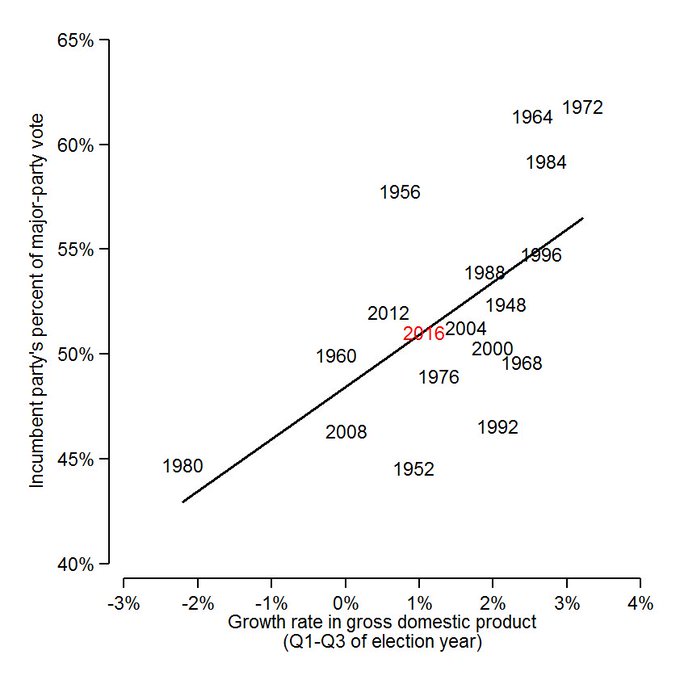
Elections, Economics, Demographics, Geography

Mar-A-Lago, we have a problem:Image

A more elaborate model

D base is bigger

The GOP base is shrinking:


'Oregon is all one great white middle-class suburb."  -- RFK, 1968

Education and the states

Hopkins paper

Illinois -- see p. 39 of Jack Segal's thesis

GOP% in Key Counties.....1988.......2016

Fairfield County, CT...........59%......38%
Nassau County, NY.............57%.......45%
Orange County, CA........ ....68%.......42%
Harris County, TX...............57%.......42%

Congressional races in 2018:  the case of California


Wednesday, March 11, 2020

Emergency Changes


Because of the emergency, I am revising the syllabus for the second half of the course. Note some changes.

First, because oral presentations might be tough for those with uncertain Internet connections, you will instead simply do blog posts about your research papers (example here: http://cmc-gov123.blogspot.com/2018/04/mckenzie-oral-presenation.html). Even aside from these posts, I encourage you to step up your use of the blog as a form of class participation. There will be a great deal to think about in the weeks ahead, and the blog will be a good vehicle for sharing thoughts and information.

Second, because the Congress simulation is now going to be a much shorter class exercise via Zoom, we will not have witnesses or administration officials. I regret that participation will no longer be an option for this course.

Third, I have reorganized the schedule (scroll down).
-------------------------------------------------------------------

Here is the research assignment

Pick one:
  • Appraise President Trump's performance as leader of the Republican Party.  What are his goals for the party?  In light of political and institutional constraints, how well has he done?
  • Analyze the use of "message votes" (Lee, ch. 6) in 2018 and 2019. What challenges and opportunities faced each party in each chamber?  Who used these votes most successfully?  And how would you know that a message vote has succeeded?
  • Pick any state legislature.  Has it become more or less polarized over the past decade?  Why?
  • I may think of others!  Keep an eye on this space.  You may also write on another topic of your choice, subject to my approval.
The specifications:
  • Essays should be typed (12-point), double-spaced, and no more than six pages long. I will not read past the sixth page. Please submit papers as Word documents, not pdfs.
  • Cite your sources. Please use endnotes in the format of Chicago Manual of Style. Endnotes do not count against the page limit. Please do not use footnotes, which take up too much page space. 
  • Watch your spelling, grammar, diction, and punctuation. Errors will count against you. Return essays (in Word format) to the Sakai dropbox for this class by 11:59 PM, Friday, April 17. Papers will drop one gradepoint for one day’s lateness, a full letter grade after that.
========================================================================

Mar 31, Apr 2:  Party in Congress I

"On ordinary legislative matters, most members of Congress don’t think anymore. They just follow whatever they’re told by their leadership."  -- Rep. Justin Amash (I-MI)

  • Lee, ch. 1-4
Apr 7, 9:  Party in Congress II"This is a Washington, D.C. kind of lie. It's when the other person knows you're lying, and also knows you know he knows." - Henry Fonda in Advise & Consent
  • Lee, ch. 5-9.
Apr 14, 16:  Party in the States I 

"So, I am to receive thirty percent for finance, for legal protection and political influence. Is that what you're telling me? I said that I would see you because I had heard that you were a serious man, to be treated with respect. But I must say no to you and let me give you my reasons. It's true I have a lot of friends in politics, but they wouldn't be so friendly if they knew my business was drugs instead of gambling which they consider a harmless vice." -- Vito Corleone (Marlon Brando) in The Godfather  
  • Hershey, ch. 13-14.
  • Grossmann, ch. 1-2 
RESEARCH PAPER DUE IN SAKAI DROPBOX BY FRIDAY APRIL 17

THIRD 4-PAGE ESSAY ASSIGNED APR 17, DUE IN SAKAI DROPBOX BY MAY 6

 Apr 21, 23:  Party in the States II

“Democrats are...the party that says government can make you richer, smarter, taller and get the chickweed out of your lawn. Republicans are the party that says government doesn't work, and then they get elected and prove it.” -- P.J. O’Rourke
  • Grossmann, ch. 3-6
April 28, 30:  Appraisal and Reform I
 
“We're like a Third World country when it comes to some of our election practices.” – Donna Brazile
 
 May 5: Appraisal and Reform II
“We all want progress. But progress means getting nearer to the place where you want to be. And if you have taken a wrong turning then to go forward does not get you any nearer. If you are on the wrong road progress means doing an about-turn and walking back to the right road and in that case the man who turns back soonest is the most progressive man.” – C.S. Lewis
  • Hershey, ch. 16.