Wednesday, April 22, 2020

Anti-Shutdown and Antivax Movements in the States

Kenneth P. Vogel, Jim Rutenberg and Lisa Lerer at NYT:
An informal coalition of influential conservative leaders and groups, some with close connections to the White House, has been quietly working to nurture protests and apply political and legal pressure to overturn state and local orders intended to stop the spread of the coronavirus.

The groups have tapped their networks to drive up turnout at recent rallies in state capitals, dispatched their lawyers to file lawsuits, and paid for polling and research to undercut the arguments behind restrictions that have closed businesses and limited the movement of most Americans.

Among those fighting the orders are FreedomWorks and Tea Party Patriots, which played pivotal roles in the beginning of Tea Party protests starting more than a decade ago. Also involved are a law firm led partly by former Trump White House officials, a network of state-based conservative policy groups, and an ad hoc coalition of conservative leaders known as Save Our Country that has advised the White House on strategies for a tiered reopening of the economy.

The effort picked up some influential support on Tuesday, when Attorney General William P. Barr expressed concerns about state-level restrictions potentially infringing on constitutional rights, and suggested that, if that occurred, the Justice Department might weigh in, including by supporting legal challenges by others. Separately, in Wisconsin, Republicans in the state legislature sued to block the Democratic governor’s order extending stay-at-home rules through May 26.
...
Support for the protests features more direct ties to the White House than simply support for Mr. Trump. The administration recently formed an advisory group for reopening the economy that included Stephen Moore, the conservative economics commentator. Mr. Moore had been coordinating with FreedomWorks, the Tea Party Patriots and the American Legislative Exchange Council in a coalition called “Save Our Country,” which was formed to push for a quicker easing of restrictions.

At my autism blog, I have a post about the overlap between the anti-shutdown movement and the antivaccine movement. 

A year ago,  Arthur Allen reported at Politico that Republican state legislators are taking up the antivaccine cause:
The GOP tilt is more pronounced among state lawmakers than among federal ones; many prominent Republicans in Congress including most of the 16 GOP doctors have endorsed vaccines. The most visible and voluble exception is Sen. Rand Paul (R-Ky.), an ophthalmologist who says his own kids were vaccinated but the decision should be left to the parents, not the government.
But in states where legislators have advanced serious efforts to tighten restrictions, such as Maine, Washington, Colorado and Oregon, nearly all of the opponents are Republicans who’ve taken a medical freedom stance.
“The more they dig into it being about freedom, the more susceptible they become to the theories,” said Dave Gorski, a Michigan physician who has tracked the anti-vaccine movement for two decades. “Appeals to freedom are like the gateway drug to pseudoscience.”
At the extremes are legislators like Jonathan Stickland, a pro-National Rifle Association, Christian conservative in the Texas Assembly, who has described vaccines as “sorcery” while personally attacking Baylor University scientist Peter Hotez, who has a daughter with autism and works on vaccines for neglected tropical diseases. “Parental rights mean more to us than your self-enriching 'science,'" Stickland tweeted at Hotez earlier this month.
That same day, the Oregon Republican Party’s official Twitter account posted that Oregon Democrats were “ramming forced injections down every Oregon parent's throat.”
Other Republican state officials have blamed Central American immigrants for disease outbreaks, echoing a talking point of Fox commentator Lou Dobbs. In fact, experts say, children in many of those countries are more thoroughly vaccinated than their U.S. counterparts against diseases like whooping cough and measles.

Mariel Garza at LAT:
[I]t was dismaying to see state Senate Minority Leader Sen. Shannon Grove of Bakersfield and other Republican legislators side with the opponents on the bills to close a loophole that was allowing people to get around the state’s vaccination laws.
...
If this is a ploy to turn the so-called “anti-vaxxers” into GOP voters, they may not have great luck. Those opposed to mandatory vaccines don’t split along party lines. In fact, some of the places that have seen the lowest vaccination rates are solidly liberal communities, like Marin County and Santa Cruz.

Tuesday, April 21, 2020

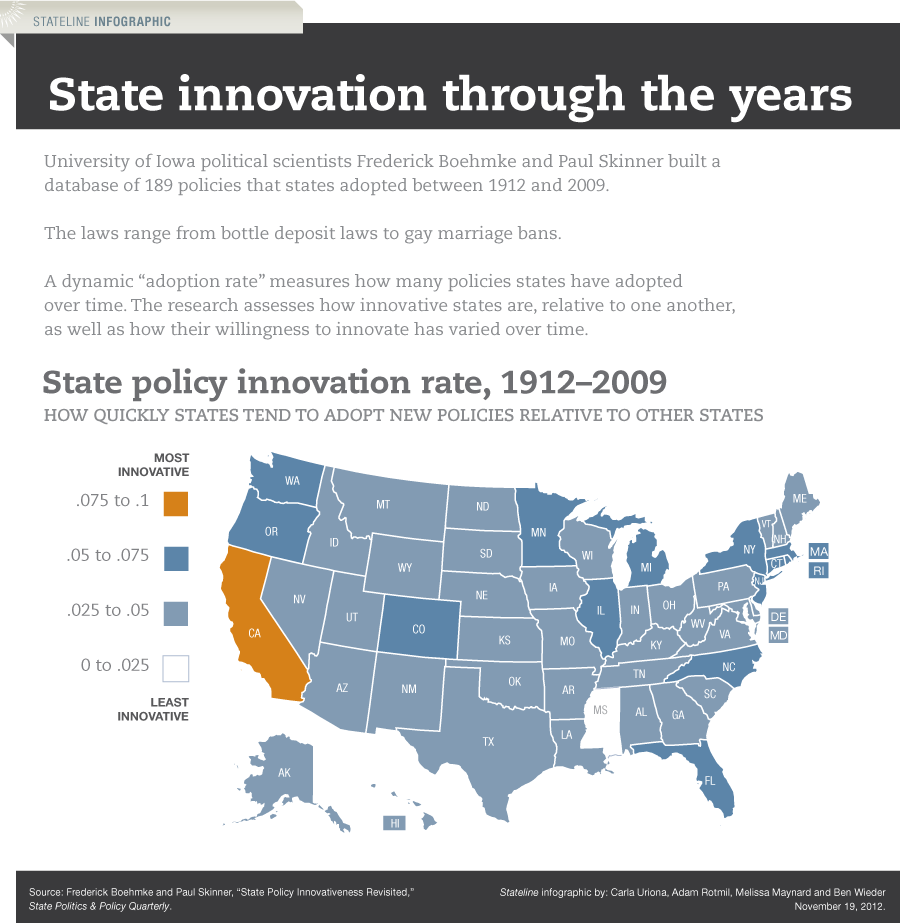
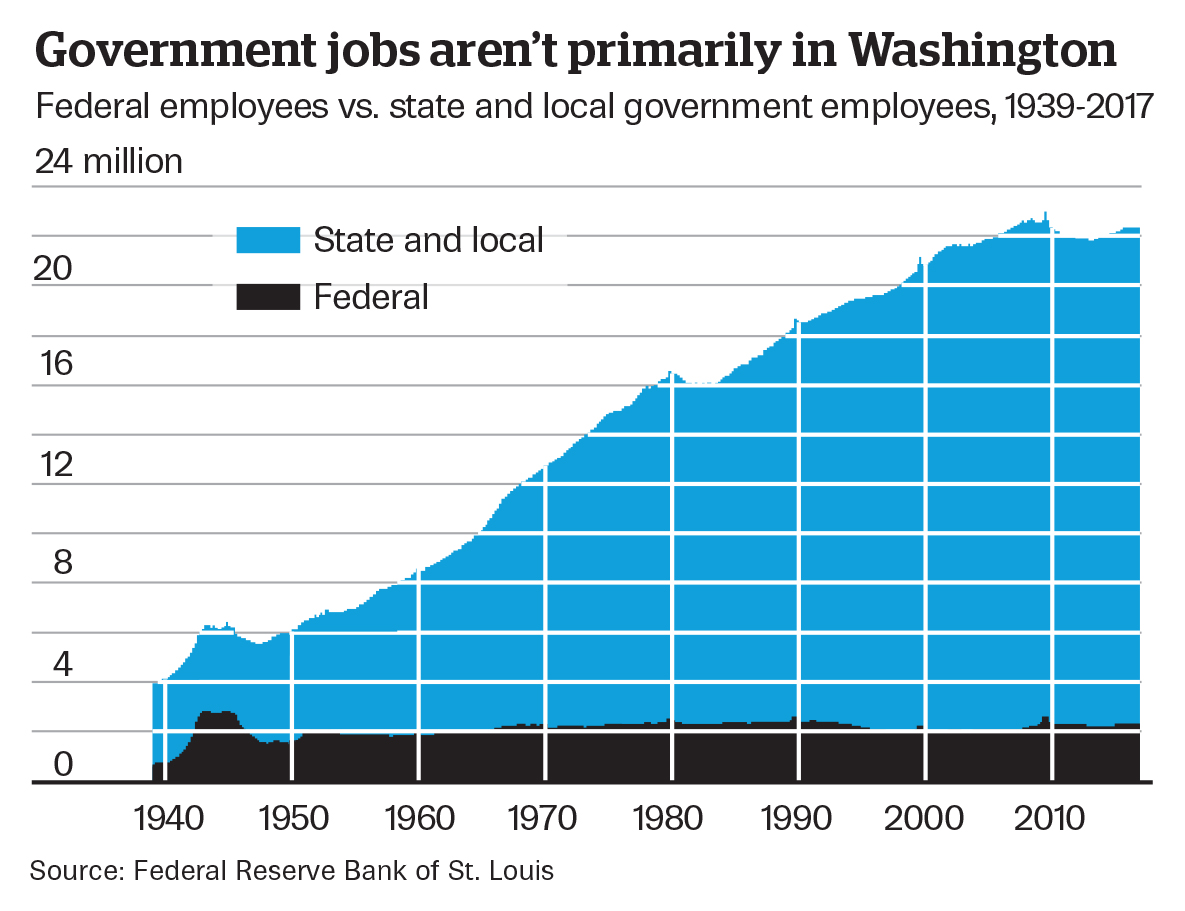
State Governments: Innovation and Stickiness

Maddy asked about state government innovation: 11_19_INFOGRAPHIC_innovation-index

A different ranking from a pro-business perspective.


"Sticky" liberal policymaking

The workforce:


DANNY: Why the differences?

Character of employment
Federal mandates on state and local government
Power of unions (in CA, NY and some other big states)

What states and localities spend money on:


Medicaid:  the program Republicans hate to love.


Education:

Charter schools are public schools.

People are generally happy with their own local schools

The Lieutenant Governor of Texas

In some states (e.g., California), the lieutenant governor is little more than a cipher.  In Texas, however, the office holds great power. Among other things, its occupant gets to appoint committee chairs in the State senate.

Monday, April 20, 2020

COVID-19 & Elections

COVID-19 has (fairly obviously) impacted elections, as in-person voting could spread the disease. 19 states have postponed their upcoming primary elections due to COVID-19, almost all through executive order. This has proved relatively uncontroversial except for in Ohio and Wisconsin, where decisions to delay their respective elections were fought out in court.

First, in Ohio, Governor DeWine (R) did not oppose holding their March 17 election until the day prior, when he convinced two Ohio residents to file a lawsuit to change the date of the election (as he contended he did not have the power to do so). When that failed, his Health Director, Dr. Acton, issued the polls closed on the eve of the election in order to protect the health of voters. A candidate on the ballot asked the Ohio Supreme Court to weigh in, but it refused to do only hours before polls were originally set to open.

In Wisconsin, Governor Evans (D) discounted calls to postpone their primary set for April 7 given that there were municipal races in addition to one for a state Supreme Court race set to occur. Interest groups filed several lawsuits asking for changes to the election, culminating with an April 2 decision by a federal district court judge to allow any absentee ballot received by April 13 (and not necessarily postmarked by April 7 as required by statute) to be counted as valid. Governor Evans had a change of heart on April 3 and called the legislature into special session on April 4 to consider postponing the election, but it refused with both chambers only in session for less than a minute before adjourning. On April 6, Governor Evans declared the election moved by executive order. The legislature promptly sued, and a 4-2 partisan-line ruling from the Wisconsin Supreme Court struck down his order as an overreach of his emergency powers. A 5-4 partisan-line ruling an hour late from the federal Supreme Court also struck down part of the district court's ruling allowing absentee ballots not postmarked by April 7 but received by April 13 to be counted as valid. Thus, when voters went to the polls the next day, there was lots of confusion and long lines.

Modifying the terms of the election itself has proved more controversial. 16 states currently require an excuse to vote absentee, but 8 of these states have waived their excuse requirements for their upcoming election. Of the 8 remaining states, 6 are Republican trifectas and the other 2 have Democratic governors but Republican-controlled legislatures. Litigation has proved successful so far in handling opposition by Republican state officials.


Campaigns have also had to adjust to a new normal without canvasing and rallies. Especially for challengers in House or state legislative races, conducting virtual campaigning has been difficult as they have little staff or money when compared to incumbents. Even presidential candidates have been forced to rely on Twitter, Facebook, and text messages to get their messages across.

The political system as a whole needs to be more prepared for future election emergencies. As law professor Michael Morley writes, few state statues have comprehensive planning for a crisis that occurs around an election. He recommends implementing state statues that allow for election modification, postponement, and cancellation depending on the circumstances. Interest groups ranging from the Brennan Center to Free Speech For People have also rolled out their own plans for the upcoming elections.


Political Networks and Anti-Quarantine Protests


Isaac Stanley-Becker and Tony Romm at The Washington Post:
A trio of far-right, pro-gun provocateurs is behind some of the largest Facebook groups calling for anti-quarantine protests around the country, offering the latest illustration that some seemingly organic demonstrations are being engineered by a network of conservative activists.

The Facebook groups target Wisconsin, Ohio, Pennsylvania and New York, and they appear to be the work of Ben Dorr, the political director of a group called “Minnesota Gun Rights,” and his siblings, Christopher and Aaron. By Sunday, the groups had roughly 200,000 members combined, and they continued to expand quickly, days after President Trump endorsed such protests by suggesting citizens should “liberate” their states.

The Dorr brothers manage a slew of pro-gun groups across a wide range of states, from Iowa to Minnesota to New York, and seek primarily to discredit organizations like the National Rifle Association as being too compromising on gun safety. Minnesota Gun Rights, for instance, describes itself as the state’s “no-compromise gun rights organization.”

The online activity instigated by the brothers helps cement the impression that opposition to the restrictions is more widespread than polling suggests. Nearly 70 percent of Republicans said they supported a national stay-at-home order, according to a recent Quinnipiac poll. Ninety-five percent of Democrats backed such a measure in the survey.

Sunday, April 19, 2020

From Charlie: Trump as Party Leader

 Question: Is President Trump a strong leader of the Republican Party?

Answer: Yes/No, depending on how you define “strong leadership”

Pro Argument

· He has a 90% approval rating among registered members of the Republican Party

· Trump is delivering to the core factions of the Republican Party
  • Fiscal Conservatives: Tax Cuts
  • Social Conservatives: Judicial Appointments
  • Business Conservatives: Deregulation
· Not only is he delivering to the GOP’s core factions, he has created a new faction of the Republican Party: Nationalist Conservatives
  • Nationalist Conservatives support Trump’s anti-immigration policies and trade deal alterations
Together fiscal conservatives, social conservatives, business conservatives, and nationalist conservatives make up at least 80% of the Republican Party.

Con Argument

· While Trump is delivering to the core factions of his party, he is alienating voting demographics that will be important to GOP success in the future
  • Minorities
  • Young Voters 

· Minorities and Young people vote Democratic:
  • Minority voters: comprise 40% of the Democratic party compared to the GOPs 12%.
  • Young voters: 59% of millennial voters identify as Democrats or lean Democratic, while only 32 percent identify as Republicans or lean Republican.
Trump’s xenophobic rhetoric makes the Republican party less appealing

Implications for the Future:
  • Voter turnout rates among these demographics was higher in 2018 than in 2014
Summary of voter turnout between 2014-2018:
  • Asian turnout: 26.9% to 40.2%
  • Black turnout: 40.6% to 51.4%
  • Hispanic turnout: 27%to 40.4%
  • Young turnout (ages 18-29): 19.9% to 35.6%


Not only is voter turnout increasing, but these demographics are becoming a larger proportion of the electorate

Minorities

  • Minorities made up 13% of the electorate in 1980
  • Minorites made up 26% of the electorate in 2016
  • Prediction by Growth and Opportunity Project: Minorities will outnumber white voters in the 2040s
Young Voters
  • Twenty years from now, by 2039, millennials and Gen Z will represent 62 percent of all eligible voters.
Takeaway: Trump’s leadership has caused a problem for the GOP because he alienates important and growing voting demographics. Trump’s divisive leadership leaves Republican Congressional leaders in a difficult situation. If they split from Trump on an issue, they may have a problem with their base; however, standing by Trump may cause future problems for the GOP.


From Maddy: Impeachment Messaging


Research Paper: Impeachment Messaging by Maddy Levine


The impeachment trial of President Donald Trump was a momentous event, marking the third impeachment of a United States President since the country’s founding. But what lies beneath the historical nature of the impeachment is what it showed about the dynamics of Republican and Democratic Parties in the Senate and House. Through researching the messaging campaigns of both parties, specifically focusing on the period of the House impeachment inquiry and vote, this process marked the breakdown of bipartisanship in and the growth of party polarization in Congress.

Convincing a Skeptical Public

Democrats challenge in the beginning of the inquiry was convincing the public that the investigation was necessary. To do this, Democrats focused messaging on a constitutional and nonpartisan obligation to pursue investigations into Trump’s infamous call with Ukraine. In contrast, Republicans faced the challenge of defending a president with an approval rating that has never broken higher than 49%. Their focus in early messaging was declaring the whistleblower report a non-credible source with a hatred for Trump.


Impeachment Inquiry

Democratic messaging remained steady in reiterating the somber nature of the inquiry, as well as that the process was not something they wished to pursue. They emphasized, especially in purple districts, that this was forced upon them by Trump himself. Meanwhile, Republicans struggled to come up with a coherent messaging scheme - messaging ranging between reframing the facts to state that while Trump did withhold aid, it was over foreign policy concerns, while others argued that the process was unjust.


Impeachment Debates

During the impeachment debates, the Democrats remained incredibly structured in their arguments. Emphasizing duty, service, and a pursuit of justice, they advocated for Representatives to vote for impeachment, and Senators to vote for removal. While Democrats invoked the Constitution, Republicans invoked the Bible, Pearl Harbor, and the end of democracy. Referencing a sense of unjust persecution, a dangerous precedent, and preserving democracy, they argued for voting against impeachment and removal.


Each party faced different challenges in winning support for cause - whether to impeach or dismiss. But with the sharp attacks against the foundations of the opposing party, and the inability of each party to agree on a single fact, it signaled the growth of party polarization, as well as the deterioration of bipartisanship within Congress. We currently are seeing the impacts, as Congress fails to come together in the face of COVID-19, still debating over the smallest amendments to relief packages.